Which Automatic Pool Cleaner Is Right for Your Pool Shape?
There’s nothing quite like staring at a dirty pool on a Saturday morning, knowing you’ll spend the next hour or two wrestling with a vacuum hose, scrubbing walls, and fishing out debris that somehow found its way into every corner. Manual pool cleaning is tedious, time-consuming, and frankly, not how most of us want to spend our weekends. That’s exactly why automatic pool cleaners exist—but choosing the right one isn’t as straightforward as it seems.
For new pool buyers especially, the sheer number of options can feel overwhelming. What many people don’t realize is that the shape of your pool plays a significant role in determining which cleaner will actually do a thorough job. A rectangular pool presents vastly different cleaning challenges than a freeform design with curves, steps, and shallow ledges. The wrong cleaner might leave dead spots, get stuck in corners, or fail to navigate slopes effectively. This guide will walk you through how to select the right electric pool cleaner based on your pool’s unique shape and characteristics, so you can enjoy crystal-clear water without the guesswork.
Understanding How Pool Shape Impacts Cleaning Needs
Pool shape isn’t just an aesthetic choice—it fundamentally determines how effectively an automatic cleaner can do its job. Every curve, corner, and transition in your pool creates areas where debris accumulates, and not every cleaner is equipped to reach them all.
Rectangular pools are the most straightforward to clean. Their flat walls and predictable angles allow most cleaners to follow simple back-and-forth patterns without missing spots. L-shaped pools introduce complexity because the cleaner must navigate around the interior corner where the two sections meet, an area notorious for trapping leaves and sediment. Freeform pools—those organic, curved designs inspired by natural lagoons—present the greatest challenge. Their irregular contours mean a cleaner relying on random movement patterns may repeatedly cover some areas while neglecting others entirely.
Then there are pools with built-in features like tanning ledges, swim-outs, steps, and varying depths. Each of these creates transitions where walls meet floors at unusual angles, slopes change gradient, or shallow areas prevent full submersion of the cleaning unit. A cleaner that excels in a simple rectangular pool may struggle to climb a gradual slope or get trapped on a wide step.
If you’re a new pool buyer, understanding these challenges early is essential. Selecting a cleaner that matches your pool’s geometry from the start saves frustration and ensures you won’t be supplementing automated cleaning with manual touch-ups every week. The key is matching the cleaner’s navigation capabilities and physical design to the specific demands your pool shape creates.
Essential Cleaning Features for Effective Pool Maintenance
When evaluating automatic pool cleaners, understanding core features helps you predict how well a unit will perform in your specific pool. Suction power is the foundation—stronger suction picks up fine sediment and heavier debris alike, but it also determines whether the cleaner can maintain grip while climbing walls or navigating slopes. Pools with gradual depth transitions or curved walls demand consistent suction that adapts to changing angles without losing contact with the surface.
Brush types matter more than most buyers realize. Foam brushes work well on tile and fiberglass, providing gentle but effective scrubbing. Rubber brushes handle textured surfaces like pebble finishes and concrete, where algae tends to cling in microscopic crevices. For pools with mixed surfaces—say, a vinyl floor with tile at the waterline—look for dual-brush systems or interchangeable brush options that won’t damage delicate materials while still removing stubborn buildup.
Filtration capacity directly affects how long a cleaner can operate before requiring attention. Fine-mesh filters capture particles down to two microns, keeping water polished between chemical treatments. Larger debris baskets accommodate leaves and twigs without clogging mid-cycle, which is particularly important for freeform pools surrounded by landscaping. Navigation technology ties everything together. Random-pattern cleaners work acceptably in simple rectangular pools, but they waste energy and time in complex shapes. Systematic navigation uses onboard sensors or pre-programmed algorithms to ensure complete coverage, making it essential for L-shaped pools or designs with alcoves and swim-outs where random movement creates persistent dead zones.
Advanced Features for Tackling Complex Pool Shapes
Smart mapping technology represents the biggest advancement for irregularly shaped pools. Cleaners equipped with gyroscopes and accelerometers build an internal map of your pool’s dimensions during their first cycle, then optimize subsequent cleaning paths to eliminate missed spots. This is transformative for freeform designs where no two walls follow the same curve. Adjustable scrubber widths allow the unit to reach into tight corners where standard-width cleaners simply bounce off and redirect. Anti-tangle cable systems use swivel connections and memory-free cord designs to prevent the power cable from knotting around itself during complex maneuvers—a common frustration in pools with islands, raised walls, or multiple level changes. For multi-level pools with tanning ledges or deep-end transitions, look for cleaners with variable-speed drive motors that automatically adjust torque when encountering slope changes, preventing the unit from stalling or flipping on inclines.
Pool Cleaning Comparison: Electric Models vs. Other Types
Understanding the differences between pool cleaner types is essential before investing in one, particularly when your pool shape demands specific capabilities. The three main categories—robotic (electric), suction-side, and pressure-side cleaners—each approach the job differently, and their effectiveness varies dramatically depending on pool geometry.
Suction-side cleaners connect to your pool’s existing filtration system and use the pump’s suction to move around and collect debris. They’re the most affordable option and work reasonably well in simple rectangular pools with flat floors. However, they struggle with complex shapes because their movement is largely random and driven by water flow rather than intelligent navigation. In an L-shaped or freeform pool, they frequently get stuck in corners, miss curved sections, and can’t reliably climb walls with irregular angles. They also add strain to your pool pump and filter, increasing energy costs and wear on existing equipment.
Pressure-side cleaners use water pressure from a dedicated booster pump or the return line to propel themselves and sweep debris into an attached bag. They handle larger debris like leaves and acorns better than suction models, making them popular for pools surrounded by trees. Their movement patterns are somewhat more predictable, but they still lack true navigation intelligence. In pools with tanning ledges, swim-outs, or multiple depth transitions, they often bypass shallow areas entirely or get caught on steps.
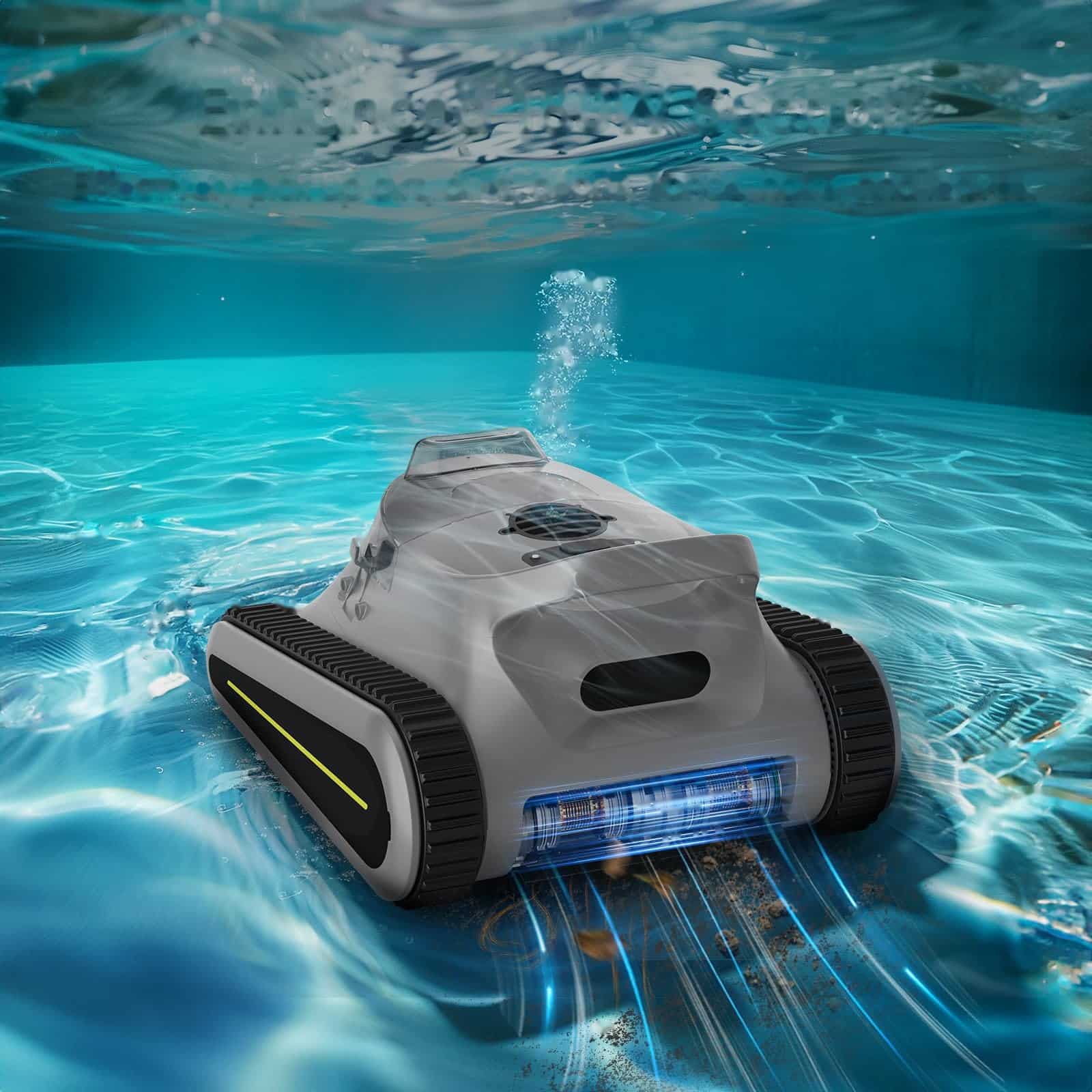
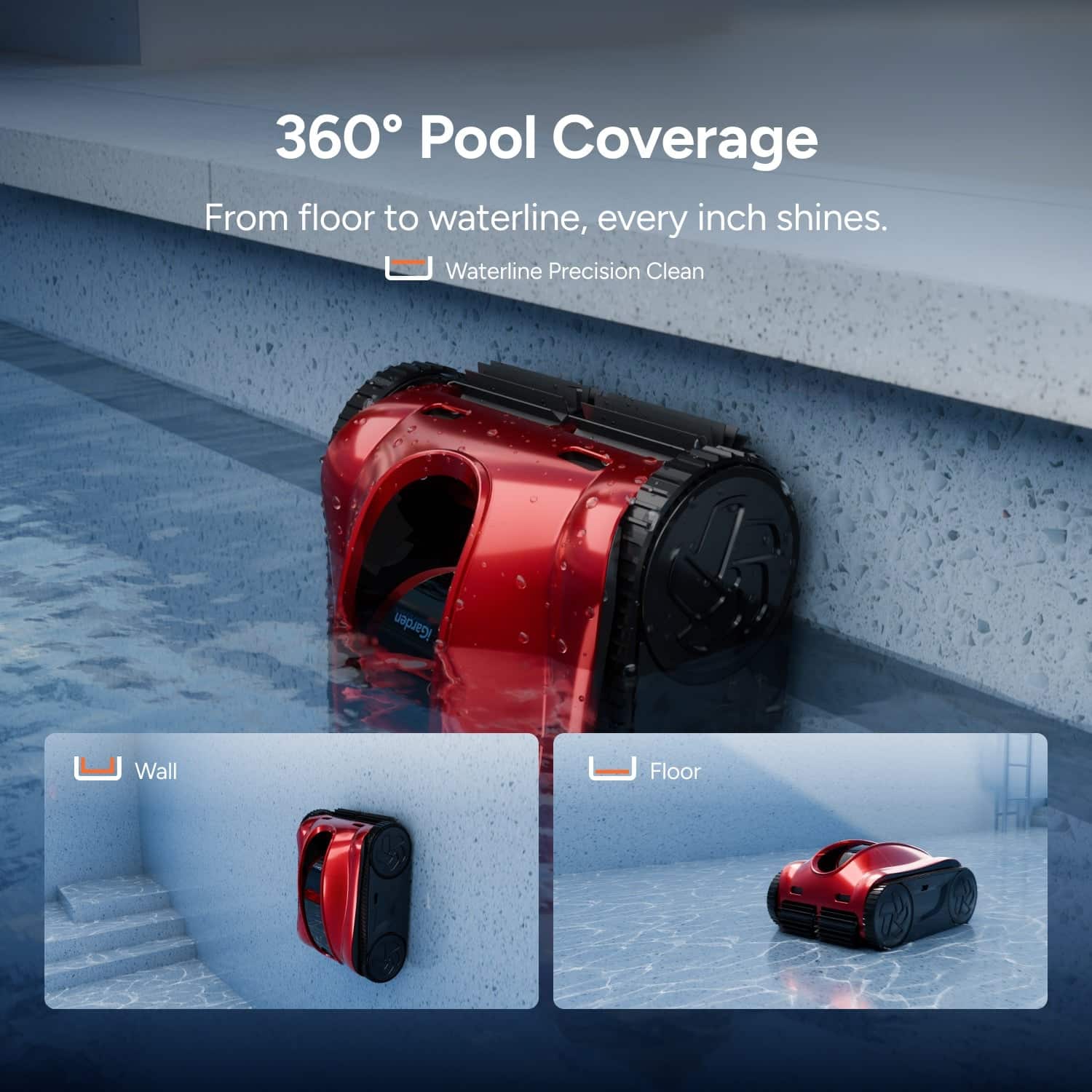
Electric robotic cleaners operate independently from your pool’s filtration system, running on low-voltage power through a floating cable. This independence is their first major advantage—they don’t tax your pump or filter, and they consume significantly less energy overall. More importantly for complex pool shapes, electric models are the only category that commonly incorporates smart navigation technology. Their onboard processors allow systematic coverage patterns that adapt to curves, corners, and elevation changes in real time. They carry their own filtration, which means fine particles get captured without cycling through your main system. Wall-climbing capability is standard on most electric models, and higher-end units handle waterline scrubbing on curved surfaces that would stymie other cleaner types. The trade-off is a higher upfront cost, but for freeform, L-shaped, or feature-rich pools, electric cleaners deliver the most complete and consistent results. They’re also the quietest option during operation, since they don’t rely on your pump running at full capacity. For new pool buyers with anything beyond a basic rectangular design, electric robotic cleaners represent the most reliable path to thorough, hands-off cleaning.
Maintenance Ease and Long-Term Considerations
Beyond cleaning performance, the ongoing maintenance demands of your automatic pool cleaner deserve careful thought—especially if you’re a new pool owner who doesn’t yet have a sense of what routine upkeep looks like. The reality is that every cleaner requires some level of attention, but the frequency and cost vary significantly based on design choices that relate directly to your pool’s shape and environment.
Filter cleaning frequency is one of the most noticeable maintenance tasks. Cleaners operating in freeform pools surrounded by mature landscaping will fill their filter canisters or bags faster than those working in exposed rectangular pools with minimal organic debris. Units with top-access filter cartridges simplify this process considerably—you can rinse them in seconds without flipping the unit over or disassembling components. Larger capacity filters mean fewer interruptions during a cleaning cycle, which matters when your cleaner needs extended run times to cover complex geometries.
Brush and track replacement is another long-term consideration. Textured pool surfaces like pebble or exposed aggregate wear down brushes faster than smooth fiberglass or tile. If your pool has multiple surface types across different zones, you’ll want a model with easily replaceable brush modules rather than integrated designs that require professional servicing. Tracks and wheels on climbing-capable cleaners also wear unevenly in pools with steep walls or sharp transitions, so look for modular treads you can swap at home.
Durability varies with build quality, but also with how hard the cleaner works. A unit constantly navigating tight corners, climbing irregular walls, and reversing direction in an L-shaped pool experiences more mechanical stress than one gliding across a flat rectangular floor. Investing in a model built for complex environments—with reinforced drive motors and corrosion-resistant internals—pays off over years of reliable service rather than premature breakdowns that leave you back on manual duty.
Step-by-Step Guide to Choosing Your Perfect Electric Pool Cleaner
Selecting the right electric pool cleaner doesn’t need to be complicated if you approach it systematically. Start by assessing your pool’s shape and size—measure the total surface area, note every curve, corner, step, and depth transition, and identify spots where debris naturally accumulates. This gives you a clear picture of what your cleaner must handle.
Next, identify your must-have features based on your specific environment. If your pool is surrounded by trees, prioritize large debris capacity. If you have a freeform or L-shaped design, smart navigation with mapping technology becomes non-negotiable. Pools with textured finishes need aggressive brushing systems, while fiberglass or vinyl surfaces call for gentler options. Then compare electric models against these criteria directly—focus on navigation intelligence, wall-climbing ability, and how each unit handles the transitions and features present in your pool. Don’t just read specs; look for user feedback from owners with similar pool shapes. Resources from smart home platforms like iGarden can also help you compare how different models integrate into broader automated home maintenance routines.
Factor in maintenance requirements and your budget holistically. A cheaper unit that needs brush replacements every few months or leaves dead spots you clean manually isn’t actually saving money. Finally, match your findings to common scenarios: simple rectangular pools perform well with mid-range electric cleaners using systematic patterns, L-shaped pools need smart mapping and strong corner navigation, and freeform designs with multiple features demand top-tier units with adaptive drive systems and adjustable scrubbing widths. Trust the process, and you’ll land on a cleaner that genuinely fits your pool rather than one that forces compromise.
Match Your Pool Shape to the Right Cleaner for Effortless Results
Choosing the right automatic pool cleaner ultimately comes down to understanding what your pool demands. Shape isn’t just a design preference—it’s the single biggest factor determining whether a cleaner will deliver spotless results or leave you grabbing a brush every weekend. Rectangular pools offer flexibility in cleaner selection, but the moment curves, corners, multiple depths, or built-in features enter the equation, you need a machine with the intelligence and physical capability to match.
The essential features discussed here—smart navigation, appropriate brush systems, adequate filtration capacity, and reliable wall-climbing ability—aren’t luxury add-ons. They’re the difference between a cleaner that works and one that frustrates. Pair those capabilities with realistic expectations about maintenance, and you’ll avoid the common trap of buying based on price alone only to spend more in replacements and manual labor down the road.
For new pool buyers, the investment in research now pays dividends for years. Take the time to map your pool’s unique characteristics, match them against the features that matter most, and choose an electric cleaner built for your specific geometry. Your weekends belong to you—not to a vacuum hose. Start applying this guide today, and enjoy the clean, clear water you deserve without the effort you dread.


